

Practical steps to shorten your revenue cycle and free up cash trapped in receivables
If you run finance for a clinic, hospital, or multi entity healthcare group in the UAE or wider GCC, you already know the pain. Revenue looks strong on paper, but the cash never seems to show up on time. The gap between what you’ve earned and what you’ve actually collected is measured in AR days, and in GCC healthcare that number is almost always too high.
Here’s how to bring it down, based on what actually works inside a real healthcare finance function.
What “Good” Looks Like
Most GCC healthcare providers run AR days somewhere between 60 and 120. Well run operations get this down to 30 to 45 days. That gap isn’t cosmetic. For a mid sized clinic group billing AED 5 to 10 million a month, cutting AR days by 30 can free up AED 5 to 10 million in cash that’s currently sitting in limbo between claim submission and payment.
Why AR Days Stay High
A few things usually cause it. Claims get submitted late, or submitted with errors, and every day between the patient visit and the claim going out is a day added to your cycle. Denials get lumped in with slow paying claims instead of being treated as their own category, which hides the real problem. Nobody actually owns the revenue cycle end to end, so bottlenecks don’t get noticed until they show up in the monthly numbers weeks later. And self pay collection often gets treated the same way as insurance collection, when it really needs its own cadence entirely.
Where the Industry Actually Stands
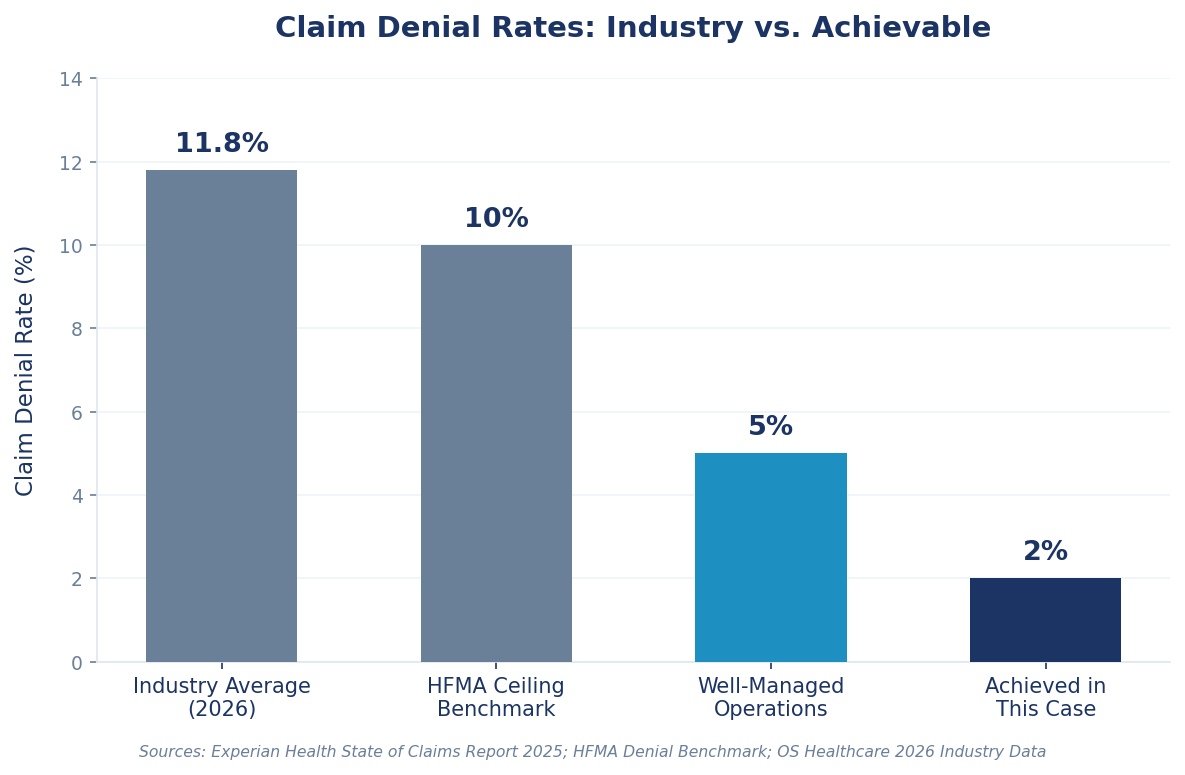
The numbers have been moving in the wrong direction. Initial claim denial rates hit 11.8% industry wide in 2026, up from 10.2% just a few years earlier. Experian Health’s 2025 State of Claims report found 41% of providers now facing denial rates at or above 10%. HFMA still sets the standing benchmark for an acceptable denial rate at 5 to 10%, but a growing share of providers are missing even that ceiling.
In one healthcare group I led finance for, we brought denials down to under 2%, well below every one of those benchmarks. Here’s how that comparison actually looks.
[CHART_PLACEHOLDER]
What Actually Moves the Number
We split the insurance department into three distinct roles instead of having one team do everything. One person handled approvals. A second person independently cross verified the billing and coding on the EMR, a genuine second set of eyes rather than a rubber stamp. Then a supervisor reviewed both people’s work thoroughly before anything went out the door. Three checkpoints on every claim, not one.
We also built code level flags into the submission process itself, so incomplete fields or clearly wrong codes got caught before a claim ever left the building, instead of relying on the payer to catch it and send it back weeks later.
Finance reconciled billing doctor by doctor, not just in aggregate, and this turned out to be where a lot of the real value sat. Doctor level reconciliation surfaces patterns that never show up in a portfolio wide number, like a specific doctor whose claims kept using the wrong code. Catching that meant we could correct it before the next rejection, or if a rejection did land anyway, we already had the correction ready to go.
Receivables meetings ran weekly, not monthly, because denials and slow pays compound fast. As finance director I sat in on those and got personally involved in following up on insurance issues when needed, rather than just reviewing a report after the fact. There was also always someone from senior management on standby who could jump in immediately when an issue needed more weight behind it, like a disputed denial or a stalled payer relationship.
Last thing, and honestly one of the most important: we tied team bonuses to denial and collection targets. An insurance team chasing a target they’re personally rewarded for behaves differently than one just processing claims as routine work.
Lower AR days also make the cash side much easier to plan. Once you know how long each payer really takes, you can build that into a healthcare revenue forecast and run a simple weekly routine around it, as set out in our guide to healthcare treasury management.
Free Download
13 Week Cash Flow Forecast Template
Collecting faster is only half the picture. See how insurer delays and denials change your cash week by week with this free Excel workbook.
The Bottom Line
AR days aren’t really a billing department problem. They’re a finance leadership problem, because they directly determine how much cash your organisation actually has to work with. Fixing them takes the same rigor you’d apply to any other core financial control: clear ownership, weekly visibility, and a process built around speed as much as accuracy.
OzaniX Partners provides fractional CFO and revenue cycle advisory for healthcare organisations across the UAE and GCC, built on 17 years of hands on financial leadership inside multi entity healthcare groups. If AR days are quietly draining your cash position, book a discovery call and we’ll walk through where the leaks actually are.
Related Service
Want this handled for you? See our Insurance and Revenue service.
Sources: Experian Health, State of Claims Report 2025; Healthcare Financial Management Association (HFMA) denial rate benchmark; OS Healthcare, 2026 industry denial data.